Palm Reading Guide: How to Read Palms for Beginners
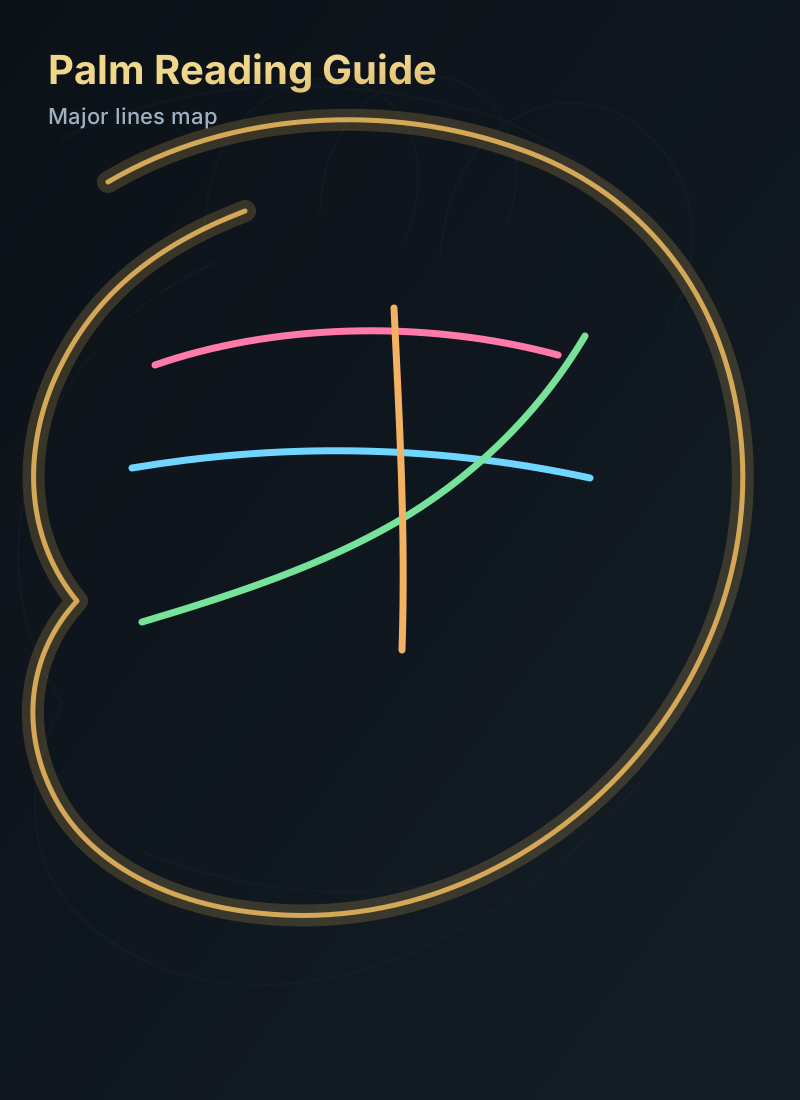
Curious about what your hands reveal? Palm reading, also known as palmistry or chiromancy, is one of the oldest forms of divination in the world. For thousands of years, people have studied the lines, shapes, and mounts of the palm to gain insight into personality, potential, and life patterns. This comprehensive guide covers everything a beginner needs to start reading palms with confidence.
What Is Palm Reading?
Palm reading is the practice of interpreting the lines, shapes, and features of the hand to understand a person's character and life tendencies. Its roots stretch back over 3,000 years, with traditions found across ancient India, China, Egypt, and Greece.
In Eastern palmistry, the practice tends to emphasize the flow of energy, the Five Elements, and the connection between palm features and overall well-being. Chinese palmistry often integrates astrology and the concepts of yin and yang. In Western palmistry, the focus is typically on character analysis, psychological insight, and individual potential, drawing from the Greek tradition of assigning planetary influences to different areas of the hand.
Both traditions share a core idea: the hand is a map that reflects who you are and the tendencies that may shape your path. Modern palm reading is best enjoyed as a tool for self-reflection and entertainment rather than literal prediction.
Try Your Free Palm Reading
Upload a photo of your palm and get an instant AI-powered analysis of your lines and traits.
Start Free ReadingWhich Hand Should You Read?
One of the first questions beginners ask is which hand to look at. The short answer: both.
- Dominant hand (active hand): This is the hand you write with. It tends to reflect your current life, conscious choices, and the person you are becoming.
- Non-dominant hand (passive hand): This hand often represents your innate potential, inherited traits, and subconscious tendencies.
By comparing both hands, you can see how much you've grown from your natural baseline. If the lines on your dominant hand differ significantly from your passive hand, it often suggests you've actively shaped your own path through experience and decisions.
The Three Major Lines
Almost every palm has three major lines. These are the foundation of any palm reading.
Heart Line (Love and Emotions)
The heart line runs horizontally across the upper part of your palm, from below the pinky finger toward the index or middle finger. It is traditionally associated with emotional life, relationships, and how you express love.
- Long and curving: Tends to suggest warmth, expressiveness, and a generous emotional nature
- Short and straight: Often indicates a practical, grounded approach to relationships
- Deep and clear: May reflect emotional stability and strong connections
Learn more in our detailed Heart Line (Love Line) Palm Reading Guide.
Head Line (Intellect and Decision-Making)
The head line runs horizontally across the middle of the palm, typically starting between the thumb and index finger. It reflects your thinking style, intellectual curiosity, and how you process information.
- Long line: Suggests a thorough, analytical thinker who considers many perspectives
- Short line: Often indicates quick, decisive thinking and a preference for action
- Curved line: May reflect creativity and imaginative thinking
Explore further in our Head Line Palm Reading Guide.
Life Line (Vitality and Energy)
The life line curves around the base of the thumb, starting between the thumb and index finger and arcing toward the wrist. Despite its name, it does not predict how long you will live. Instead, it tends to reflect your vitality, energy levels, and overall quality of life.
- Wide arc: Often suggests enthusiasm, a love of life, and physical vitality
- Close to thumb: May indicate a calmer, more reserved energy
- Breaks or branches: Can reflect significant life changes or periods of transformation
Read the full details in our Life Line Palm Reading Guide.
The Minor Lines
Not everyone has all minor lines, and they tend to be fainter than the major lines. When present, they add depth and detail to a reading.
Fate Line (Career and Life Direction)
The fate line runs vertically from the base of the palm toward the middle finger. It is often associated with career path, sense of purpose, and major life transitions. Some people have a clear fate line; others have a faint one or none at all.
Explore our Fate Line Palm Reading Guide for full details.
Sun Line (Success and Recognition)
The sun line, sometimes called the Apollo line, runs vertically toward the ring finger. When present, it often suggests creative talent, public recognition, or a sense of personal fulfillment.
Read more in our Success Line Palm Reading Guide.
Marriage Line (Relationships)
The marriage line (or lines) sits on the edge of the palm below the pinky finger, above the heart line. These small horizontal lines are traditionally associated with significant romantic relationships and emotional bonds.
See our Marriage Line Palm Reading Guide for interpretations.
Money Line (Wealth Potential)
The money line is not a single line but rather a set of indicators that palmists associate with financial acumen and wealth potential. These include short vertical lines beneath the ring and pinky fingers.
Discover more in our Money Line Palm Reading Guide.
See What Your Lines Reveal
Our AI analyzes your major and minor lines in seconds. Try it now for free.
Analyze My PalmHand Shapes: The Four Elements
In palmistry, hand shape provides a broad personality framework. The four types correspond to the classical elements.
Earth Hand
Square palm, short fingers. People with earth hands tend to be practical, reliable, and grounded. They often prefer hands-on work and value stability.
Water Hand
Long palm, long fingers. Water hands often belong to sensitive, intuitive, and creative individuals. They tend to be emotionally perceptive and drawn to artistic pursuits.
Fire Hand
Long palm, short fingers. Fire hands suggest an energetic, confident, and action-oriented personality. These individuals often thrive in leadership roles and dynamic environments.
Air Hand
Square palm, long fingers. Air hands tend to indicate intellectual curiosity, strong communication skills, and a love of ideas. These individuals often excel in writing, teaching, or social fields.
The Mounts of the Palm
The mounts are the fleshy raised areas on your palm. Each mount is named after a planet and reflects specific qualities. A well-developed (raised) mount suggests strength in that area, while a flat mount may indicate less emphasis.
- Mount of Jupiter (below index finger): Ambition, leadership, confidence
- Mount of Saturn (below middle finger): Responsibility, wisdom, introspection
- Mount of Apollo (below ring finger): Creativity, happiness, artistic talent
- Mount of Mercury (below pinky finger): Communication, business sense, adaptability
- Mount of Venus (base of thumb): Love, passion, vitality, warmth
- Mount of Luna (opposite side, below pinky): Imagination, intuition, subconscious
- Mount of Mars (center of palm, in two areas): Courage, resilience, assertiveness
How to Start Reading Your Own Palm
Ready to try? Follow these steps to begin your first palm reading.
- Find good lighting: Natural light works best. Hold your hand palm-up and let the lines cast slight shadows for visibility.
- Relax your hand: Keep your fingers slightly apart and your palm open, neither stretched flat nor cupped. A relaxed hand shows your lines most naturally.
- Identify the three major lines: Locate your heart line (top), head line (middle), and life line (curving around the thumb).
- Note the depth and length: Are the lines deep and clear, or faint and thin? Long or short? Straight or curved? Each variation carries different traditional meanings.
- Look for minor lines: Check for a fate line (vertical, center), sun line (toward ring finger), and any marriage lines (edge below pinky).
- Observe your hand shape: Is your palm square or rectangular? Are your fingers long or short? Match your hand to one of the four element types.
- Feel the mounts: Gently press the fleshy areas beneath each finger. Notice which ones are more developed.
- Compare both hands: Read your dominant hand for your present self and your non-dominant hand for your innate potential.
Common Myths About Palm Reading
There are many misconceptions about palmistry. Here are some of the most common myths debunked.
- A short life line means a short life: This is the most persistent myth. The life line reflects vitality and energy, not lifespan. Many people with short life lines live long, full lives.
- Palm reading can predict exact events: Palmistry reveals tendencies and personality patterns, not specific future events. It is a reflective practice, not a crystal ball.
- Only the right hand matters: Both hands contribute to a reading. The dominant hand shows your current self; the non-dominant hand reveals your innate nature.
- Lines never change: Palm lines can and do shift over time, reflecting personal growth, major life events, and changes in outlook.
- You need psychic ability to read palms: Anyone can learn the basics of palmistry. It is a skill built on observation and knowledge of traditional meanings, not supernatural power.
Frequently Asked Questions
Which hand should you read in palm reading?
Most palmists read both hands. Your dominant hand reflects your current life and choices, while your non-dominant hand represents your innate potential and inherited traits. Comparing both hands can reveal how much you've developed your natural abilities.
What are the three major lines in palm reading?
The three major lines are the heart line (emotions and relationships), the head line (intellect and decision-making), and the life line (vitality and life energy). Nearly everyone has these three lines, though they vary greatly in length, depth, and shape.
Does a short life line mean a short life?
No, this is one of the most common myths about palm reading. A short life line does not predict lifespan. It tends to reflect personality traits such as a practical, grounded nature rather than the length of one's life.
Can palm lines change over time?
Yes, palm lines can and do change throughout your life. Major life events, shifts in mindset, and personal growth may all be reflected in subtle changes to your palm lines. This is why many palmists suggest revisiting your reading periodically.
Is palm reading scientifically proven?
Palm reading is not scientifically proven as a method of predicting the future. It is best understood as a centuries-old tradition used for self-reflection, personal insight, and entertainment. Many people find value in it as a tool for introspection rather than literal fortune-telling.
Start Your Palm Reading Journey
Every hand tells a unique story. Upload your palm photo and discover what your lines reveal about you.
Start My Reading