
Leadership Signs in Palm Reading: 7 Clues in Your Hand
Looking for leadership signs in palm reading? This guide explains seven palm clues often connected to leadership style: how you decide, handle pressure, motivate people, and grow your career. Each sign is presented with how to recognize it on your own hand, what tendencies it traditionally suggests, and the counterbalancing factors that keep the reading honest rather than flattering.
1) Clear, Stable Head Line
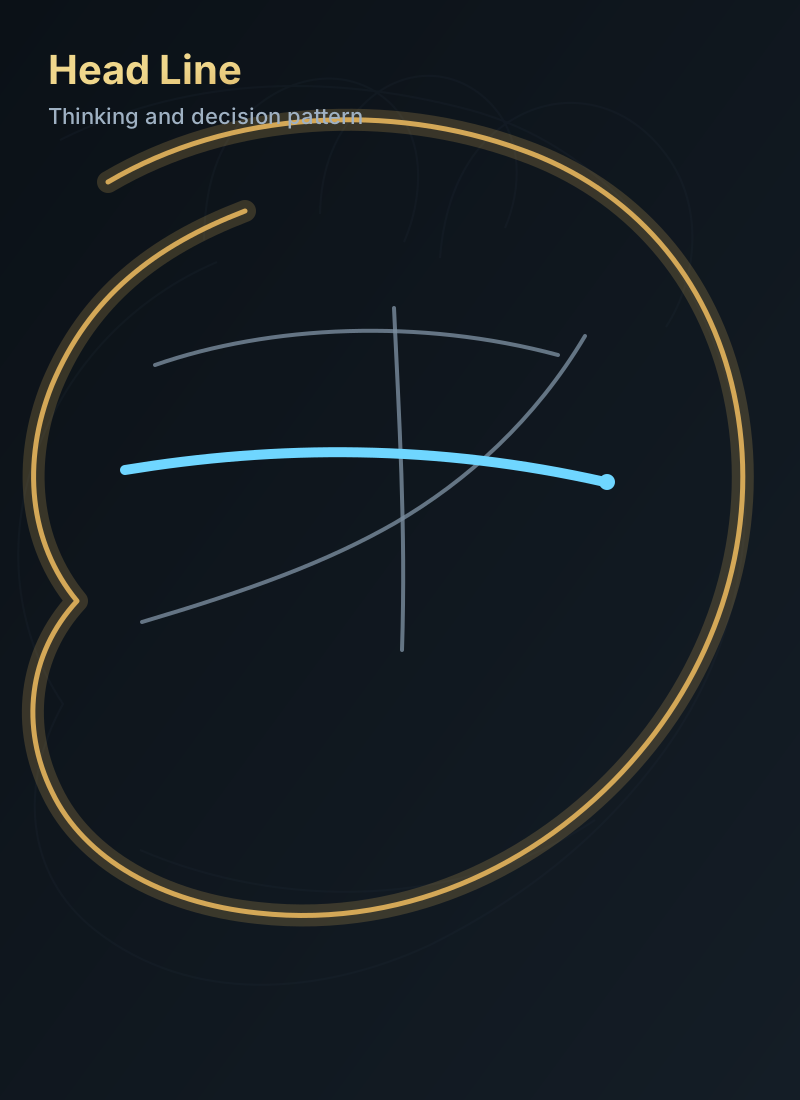
The head line crosses the middle of the palm horizontally and is traditionally read as the line of intellect, focus, and decision-making style. When palmists call it "clear and stable," they mean a single, well-defined line without heavy fragmentation, deep islands, or chaotic splits along its main course. Symbolically, this look is associated with a mind that can hold a position long enough to follow through on it.
To find it on your own palm, hold your hand open under bright light and look for the line that begins between the thumb and index finger and runs across the middle of the palm. A clear head line tends to look like one continuous mark with even depth, rather than several short lines stitched together. If you can trace it from start to end without losing the path, that is usually what readers mean by "stable."
People with this kind of head line are often described as steady thinkers who do not flip positions under social pressure. In a leadership context, that often shows up as the ability to keep a project on its core priorities even when the team is anxious or distracted. Readers often link this sign with calm meeting presence and a habit of finishing what was started rather than constantly restarting.
One caution: a very rigid, sharply etched head line can be read as overly fixed thinking. The "leadership friendly" version is clear and stable, but still has some softness — room to update when new information arrives. If your line is unusually deep and severe, the trait it suggests can tip into stubbornness rather than focus.
2) Balanced Head Line Curve
A balanced curve on the head line refers to a line that gently dips toward the wrist rather than running perfectly straight or plunging dramatically downward. In traditional palmistry, the angle of the head line is read as the meeting point between practical analysis (a straight line) and imaginative or empathetic thinking (a curved one). A balanced curve is interpreted as both at once.
To recognize it, compare the start and end of your head line. If the line ends roughly a finger-width lower than where it began, with a smooth gradual slope, that is usually called balanced. Lines that stay almost level look very analytical, while lines that drop sharply toward the base of the palm look very imaginative. The middle path is the one most associated with people-aware leadership.
The practical interpretation is the ability to balance hard goals with the human side of running a team. Leaders with this curve are often described as people who can deliver feedback without crushing the listener, push for results without losing trust, and translate strategy into language a team can actually act on. It is a sign about being able to switch registers, not about being especially nice or especially tough.
The counterbalance to remember: curve alone does not equal warmth, and straight alone does not equal coldness. The shape suggests a default thinking style, not your intentions. A perfectly balanced curve in someone who has not practiced listening will still make poor people-decisions, and a sharply curved line in someone who has worked on emotional discipline can lead beautifully.
3) Visible Fate Line
The fate line runs vertically up the center of the palm, often from near the wrist toward the base of the middle finger. It is sometimes called the line of career, life path, or destiny. A "visible" fate line simply means one that is clearly traceable for most of its length, without long gaps. Symbolically, it represents a felt sense of direction — the inner thread someone follows through their working life.
On your palm, look for a vertical line in the center, even if it is faint. Some people have no fate line at all, which is not a flaw — it is often read as someone who builds a path through choice and pivots rather than along a predetermined arc. A visible fate line tends to show up as a single line you can follow for most of its travel up the palm, even where it changes depth.
In leadership readings, a visible fate line is often interpreted as a willingness to take and hold responsibility over time. It suggests someone who can commit to a multi-year direction, accept accountability when things go wrong, and stay engaged through the unglamorous middle stretch of a project. That patience is one of the most under-discussed leadership traits, and palmists treat this line as a quiet marker for it.
A fair caution: a very deep, unchanging fate line can sometimes be read as rigidity about role or status. The healthier version is visible but allowed to branch, fade in places, or change direction — that pattern is associated with leaders who can pivot when their original path no longer serves the people they are responsible for.
4) Upward Branches Near Key Lines
Upward branches are tiny lines that fork off from a major line and travel toward the fingers rather than toward the wrist. They are most often noticed on the head line, fate line, and life line. Traditional palmistry reads upward branches as growth momentum — moments when energy is moving toward expansion, recognition, or new responsibility rather than retreating.
To spot them, look closely at the upper edge of your major lines. Branches are usually shorter and finer than the main line and lift away at a clear angle. You may need a magnifier or a phone camera to see them well. Several small upward branches scattered along a line are more meaningful than a single dramatic one — readers look for the overall pattern.
For leadership, this sign is often interpreted as ambition that points outward — willingness to take on bigger roles, propose ideas, and accept visibility. People with several upward branches are often described as those who say yes to stretch assignments and can be visible without becoming performative about it. It is a sign of quiet drive more than loud confidence.
A useful counterbalance: branches pointing downward from the same lines are not "bad," they are simply read as periods of consolidation, recovery, or inward focus. Most strong careers have both. A palm with only upward branches and no downward ones is rare, and would traditionally be read as a sign to build in deliberate rest, since the natural energy is constantly outward.
5) Strong Thumb and Palm Structure
In classical palmistry the thumb is treated almost as a separate study, because it is read as the seat of will. A strong thumb does not mean an unusually large one — it means a thumb that looks proportionate to the hand, with a firm-feeling base, a defined first joint, and a tip that does not bend backward easily. The mounts at the base of the fingers and below the thumb (the Mount of Venus) round out what readers call "palm structure."
To assess yours, hold your hand relaxed with the palm up. Look at the thumb against the rest of the hand. Does it sit at a comfortable angle, with a clear knuckle and a base that fills in the space between the thumb and index finger? Press lightly on the Mount of Venus — the rounded pad below the thumb. A firm, full feeling there is what palmists usually call "developed."
The leadership reading here is about willpower and follow-through. People with strong thumb structure are often described as those who can override momentary discomfort to stay on task, hold their position in difficult conversations, and recover from setbacks without long collapses. It is the trait most associated with stamina under responsibility — the part of leadership that looks unglamorous from the outside.
The caution worth naming: a very dominant, stiff thumb can be read as control that crowds out other people. Strong leadership thumbs are firm but still flexible enough to bend at the joint comfortably. If your thumb is rigid and never bends backward at all, the sign can tip into rigidity rather than willpower, and pairs poorly with team-based roles.
6) Few Major Breaks in Core Lines
"Core lines" usually means the head line, heart line, and life line. Breaks are clear gaps where the line stops and then resumes, sometimes offset, sometimes overlapping. A palm with few major breaks in these lines is read as a sign of continuity — an internal life that has not been forced to restart from scratch many times, or one that has integrated those restarts well.
Look for places where a line clearly stops and a new segment begins. Tiny interruptions and faint patches do not count — readers look for breaks that are visible at a glance. Most palms have a few; a palm with almost none across the major lines is unusual and is what this sign is referring to.
For leadership, this pattern is interpreted as the ability to execute through long, demanding stretches without losing direction. It is associated with people who can sustain a project through a difficult quarter, hold a team together during reorganization, or maintain personal habits when the external environment is chaotic. The trait is endurance more than brilliance.
The honest caution: breaks themselves are not negative. Many of the most influential leaders have visibly broken life or head lines, often read as significant pivots that reshaped their direction. A palm with no breaks at all can also signal a life that has not yet been tested, so this sign is most meaningful in adults whose careers have already weathered some pressure.
7) Supporting Vertical Lines
Beyond the major lines, the palm often shows smaller vertical lines, especially under the ring finger (the Sun line or Apollo line) and under the middle finger. These are read as support beams — secondary indicators that reinforce the main career and personality lines. A clear Sun line in particular is traditionally associated with public recognition and the sense of being seen for one's work.
To find them, look for short vertical lines in the upper third of the palm, beneath the base of the fingers. They are typically much shorter than the fate line and may appear singly or in small groups. A single clean Sun line under the ring finger is the classical "leadership-supportive" mark; clusters of fine vertical lines are read as energy that is present but slightly scattered.
The interpretation is about discipline and long-term drive — the qualities that turn a job into a career someone is associated with. Readers often link supporting vertical lines with personal branding in a non-cynical sense: the ability to do work distinctive enough that people remember it. They also tend to suggest steady internal motivation rather than reliance on external rewards.
One counterbalance: a strong Sun line in the absence of a clear head line or fate line can be read as desire for visibility outpacing inner direction. The healthiest version of this sign is supporting vertical lines that complement, rather than substitute for, the major lines underneath. The supporting cast works best when the leads are also present.
How These Signs Combine: Reading the Whole Hand
No single sign on this list determines leadership style on its own. Traditional palmistry is closer to reading a face than reading a chart — you look at how features relate, not at one feature in isolation. A clear head line paired with a strong thumb tells a different story than a clear head line paired with a soft, recessed thumb, even though the head line itself is identical in both cases.
A useful way to read your own palm is in pairs. Head line plus thumb tells you how decisions get made and held. Fate line plus Sun line tells you about direction plus visibility. Heart line plus head line balance tells you how naturally you mix logic and people-awareness. When you read in pairs, the signs start to describe a recognizable person rather than a checklist.
It is also worth noticing what is missing. A palm with strong drive markers but a faint heart line might point to leadership that wins on results but burns out the people around it. A palm with a beautifully balanced heart line and head line but no visible fate line might point to someone who leads brilliantly within a project but resists committing to a long arc. These absences are part of the reading.
When These Signs Are Faint or Conflicting
Many readers worry when their palms do not match the descriptions cleanly. Faint lines are extremely common and should not be read as weakness. In palmistry, faintness is more often interpreted as undeveloped or quiet potential — a tendency that exists but has not yet been put under enough pressure to deepen. People in early career, or people in roles that under-use their strengths, often show this pattern.
Conflicting signs — for example, a very strong thumb but a fragmented head line — are also normal. They usually describe a real internal tension rather than a misreading. The strong thumb says the will is there; the fragmented head line says the decision-making process is still being figured out. The honest reading is that both are true, and the growth direction is to stabilize the thinking process so the will has somewhere reliable to point.
If your palm shows almost none of the seven signs above, it does not mean leadership is closed off to you. It usually means the traditional markers of formal leadership are not the dominant story your hand is telling. Many palms point to other strengths — craft, care, creative depth — that lead in different ways. Use this guide as one frame, not as a verdict.
Beyond the Lines: Mounts and Finger Shapes
Lines get most of the attention, but classical palmistry gives almost equal weight to the mounts (the fleshy pads at the base of each finger and below the thumb) and to finger shapes. For leadership readings, the Mount of Jupiter (under the index finger) is the most relevant mount. A well-developed Jupiter mount is traditionally read as natural authority and comfort with responsibility — the willingness to be "the one" that others look to.
Finger shapes also matter. A long, firm index finger is often read as drive to lead, sometimes called the "commanding" finger. Spatulate or square fingertips are associated with practical, action-oriented leadership, while conic or pointed fingertips suggest a more inspirational, vision-led style. Neither is better; they describe what kind of leadership feels native.
Spend a moment comparing the height of your index finger to your ring finger. If the index finger reaches noticeably higher than the ring finger, that is sometimes interpreted as a natural pull toward authority roles. If they are about even, the reading typically points to leadership that prefers collaboration over hierarchy. These are subtle markers, but combined with the seven line-based signs above they round out a fuller picture.
FAQ
Can palm reading show leadership potential?
It can suggest tendencies like decisiveness, communication style, and resilience, but it is not a formal assessment. Treat it as a reflection prompt rather than a personality test.
Which line is most related to leadership?
Readers commonly prioritize the head line and fate line, then check supporting vertical lines for career consistency. The thumb and Mount of Jupiter are also studied for willpower and natural authority.
Do strong lines guarantee success?
No. Skills, execution, opportunity, and the people around you matter far more than line shape. Palm readings should guide reflection only.
Are leadership signs in the palm genetic or do they develop?
Most major lines are present from birth and shaped by genetics, but minor lines and finger shape can shift subtly with age and habit. Palmists generally treat the broad pattern as stable and the fine detail as evolving.
Should I read leadership signs from my dominant or non-dominant hand?
Traditional palmistry reads the non-dominant hand for inherited tendencies and the dominant hand for what the person has developed. For leadership, comparing both hands is often more useful than either alone.
Can leadership signs change over time?
Major lines like the head line and fate line are quite stable, but small supporting lines and the depth of the mounts can shift across years. Many readers see this as the palm reflecting how someone has grown into responsibility.